Quick answer: Hard water scale builds up fast inside an instant hot water dispenser because its small tank heats water to near-boiling. Orange County water is hard; one local district reports averages of 18 to 20 grains per gallon. Scale can cause spitting, slow reheating, and early failure. A softener, scale inhibitor, or regular descaling helps protect the unit.
Few kitchen upgrades feel as immediately luxurious as an under-sink instant hot water dispenser. Whether you are steeping French press coffee at dawn, flash-blanching herbs for dinner, or sterilizing baby bottles in seconds, having near-boiling water on tap changes the rhythm of your kitchen.
Over time, though, the honeymoon can end.
First comes the spitting. You pull the tap handle, and instead of a steady, steaming stream, the spout sputters and splatters hot water across your countertop. A few weeks later, the water temperature drops from steaming hot to lukewarm. Soon after, you hear strange rumbling from inside the cabinet beneath the sink, then complete silence: the heating element has burned out, the tank has tripped its thermal fuse, or, worse, a hairline fracture in the reservoir has leaked onto your cabinetry.
If you live in Orange County or elsewhere in Southern California, this breakdown is often not an equipment defect. It is a common result of hard water damage to an instant hot water system in Southern California.
Southern California’s water is hard, and hard water is tough on small heating appliances. When you heat mineral-rich water to near-boiling in a compact, enclosed metal chamber, you create conditions for rapid scale buildup.
Understanding how hard water affects these systems, and putting the right protection in place, is the best way to keep your kitchen convenience from becoming a recurring replacement expense.
Why Southern California tap water is hard on appliances
To understand why your hot water dispenser is struggling, look at the geological journey your tap water takes long before it enters your neighborhood water mains.
Southern California is an arid coastal basin with limited rainfall. To keep millions of homes running, regional water utilities rely on a blended supply. Part of it travels hundreds of miles from the Colorado River through the Colorado River Aqueduct. Another portion journeys south from the Sacramento-San Joaquin River Delta via the State Water Project. The remainder is pumped from deep local groundwater basins recharged by mountain runoff.
Along every mile of that path, water acts as a universal solvent. It picks up dissolved minerals along the way, mainly calcium and magnesium.
Water hardness is measured in grains per gallon (GPG). The U.S. Geological Survey classifies hardness in milligrams per liter (mg/L) of calcium carbonate. One grain per gallon equals about 17.1 mg/L, so the same scale looks like this in grains per gallon:
- Soft: 0 to 60 mg/L (up to about 3.5 GPG)
- Moderately hard: 61 to 120 mg/L (about 3.5 to 7 GPG)
- Hard: 121 to 180 mg/L (about 7 to 10.5 GPG)
- Very hard: Above 180 mg/L (above about 10.5 GPG)
In Orange County, the Yorba Linda Water District reports that imported Colorado River and Northern California water averages 18 grains of hardness, while its local well water averages 20. Hardness varies by city and water source, so your own number may differ. By the time that water enters your home, it carries a heavy mineral load.
Why instant hot water dispensers scale up first
You might wonder why your standard cold-water tap runs fine while your instant hot-water unit dies early. The answer lies in basic thermal chemistry.
Calcium carbonate stays dissolved fairly easily in cooler water. However, calcium carbonate exhibits what chemists call retrograde solubility: unlike sugar or salt, which dissolve faster in hot water, calcium carbonate becomes significantly less soluble as water temperatures rise.
When hard water hits an electric heating element running at 190°F to 210°F, dissolved calcium and magnesium begin to precipitate. They form solid, chalky crystals that build up on the hottest available surface: the heating coil and the inner tank walls.
In a traditional 50-gallon residential water heater, that mineral accumulation is spread across a large surface area over a decade. In an under-sink instant hot water dispenser, you are heating water to near-boiling temperatures inside a small tank. The ratio of heating power to water volume is concentrated, which makes scale buildup more likely.
How scale damages an instant hot water dispenser
When scale buildup in an instant hot water dispenser goes unaddressed, it can damage the appliance in four ways.
1. Thermal insulation and element burnout
The electric immersion element inside your dispenser relies on surrounding water to absorb its intense thermal energy. Mineral scale acts as a heavy insulating blanket. As a thick shell of calcium carbonate encases the metal coil, heat cannot escape into the water efficiently. The U.S. Geological Survey notes that calcium carbonate deposits from heated hard water can shorten equipment life and increase heating costs.
To heat the water to the set temperature, the internal element must run hotter and longer. Trapped beneath layers of scale, the heating coil can run hotter than designed. Eventually, the element can crack, short out, and fail. In a federal laboratory study of gas tankless water heaters, accelerated scale testing cut efficiency from 80 percent to 72 percent over the equivalent of 1.6 years.
2. Sensor blindness and thermal runaway
Instant hot water dispensers use delicate thermistors to monitor water temperature and tell the heating circuitry when to cycle off. When scale coats the sensor probe, the sensor can no longer read the actual water temperature.
A coated sensor can read the tank as cooler than it really is. This can cause erratic heating cycles, extra internal steam pressure, and repeated tripping of the high-limit safety switch.
3. Clogged valves and spitting faucets
As the heating element expands and contracts during heating cycles, brittle limescale layers crack off and drop to the bottom of the reservoir. Over time, the tank fills with gravel-like mineral flakes.
When you open the faucet handle, that swirling mineral debris gets swept up into the dispensing tube. The particles jam the silicone check valves and narrow aerator channels. This restriction causes the classic sputtering symptom: the faucet spits steam, drips continuously after being shut off, or stops flowing entirely.
4. Pitting corrosion and tank ruptures
Many homeowners assume that mineral scale protects metal tanks from corrosion. In reality, scale can worsen corrosion.
Beneath thick scale deposits, microscopic pockets form where water stagnates. Municipal water disinfectants like chlorine and chloramines, along with natural chloride ions, concentrate in these microscopic pockets. Without fresh water flow to dilute them, these trapped ions can create conditions that corrode metal, including copper, brass, and stainless steel. In some cases, this localized corrosion can lead to a leak under the sink.
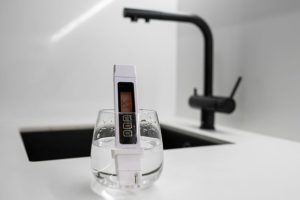
Not sure how hard your water is or what it may be doing to your dispenser? A free in-home water quality test measures hardness, chlorine, and mineral content before you spend anything on equipment. Schedule your free water treatment test or call (951) 737-1500.
Why a carbon filter alone won’t stop scale
When most people install instant hot water dispensers, contractors or homeowners add a small inline carbon filter under the sink. While carbon filtration removes municipal chlorine, chloramines, and unpleasant chemical odors, it does nothing to stop scale.
Carbon filters work through chemical adsorption. They trap organic molecules, volatile organic compounds, and disinfectants. They have zero effect on dissolved mineral ions. If you feed 18 GPG water through a standard carbon cartridge, that water will still reach your heating tank at about 18 GPG.
Relying on a carbon filter alone is one reason scale can still build up in a dispenser’s heating tank.
Three ways to protect an instant hot water dispenser from scale
Protecting an instant hot water dispenser from scale takes a plan. Depending on your home’s setup and your budget, here are three practical ways to reduce scale before it starts.
Strategy 1: Ion-exchange water softening
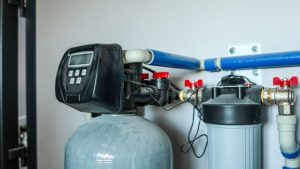
A whole-house ion-exchange water softener is the most direct way to remove the minerals that cause scale.
A traditional softener uses negatively charged resin beads to physically attract and capture positively charged calcium and magnesium ions, swapping them for neutral sodium or potassium ions. When your home’s water is softened to under 1.0 GPG, it removes the main fuel for limescale from the supply.
Investing in water softener protection for a hot water dispenser removes most of the calcium and magnesium that cause scale, which greatly reduces scale formation on the heating coil. Softened water helps keep the tank clean, protects downstream faucet valves, and gives the dispenser the best chance of reaching its full service life. Softened water also helps other heating equipment; see how a home water softener extends your tankless water heater lifespan.
Strategy 2: Polyphosphate scale inhibitors
If you do not have a whole-house water softener, an inline polyphosphate scale inhibitor cartridge is a budget-friendly point-of-use alternative.
These dedicated filter cartridges feed microscopic amounts of food-grade polyphosphate into the cold water line feeding the instant hot tank. Polyphosphate works through sequestration: it coats the dissolved calcium and magnesium ions at a molecular level, altering their crystalline structure.
Even when the water hits the hot element, the sequestered minerals are less likely to bind together or adhere to metal surfaces. They tend to stay suspended in the water and flush out of the tap. Polyphosphate filters don’t physically remove minerals, but they can help delay scale buildup on the heating element.
Strategy 3: Reverse osmosis with a compatible heating tank
Reverse Osmosis (RO) removes most dissolved solids, including minerals, by forcing tap water through a semi-permeable membrane.
However, pairing an under-sink RO system with an instant hot water dispenser requires caution. Because RO water has very few dissolved minerals, it can be more corrosive to some metals, so the dispenser’s materials matter.
To safely pair them:
- Ensure your instant hot water heating tank is rated for Reverse Osmosis water, per the manufacturer’s specifications.
- Alternatively, route the RO water through an inline remineralization cartridge to balance the pH before it enters the heating tank.
How to descale an instant hot water dispenser every six months
If you live in Southern California and feed municipal tap water through an instant hot water dispenser, routine descaling is important. Think of it like changing your car’s oil; skipping it raises the risk of early failure.
Check your manufacturer’s instructions first, then follow this general process about every six months to flush mineral buildup before it hardens:
- Cut the power: Unplug the heating tank from the wall outlet. Never service or drain the tank while it is powered, as dry-firing the element can quickly damage it.
- Depressurize and drain: Shut off the cold water supply valve feeding the filtration system. Open the hot water tap until the water stops flowing to empty the tank.
- Add a descaling agent: Use the tank’s dedicated cleaning port (or disconnect the cold inlet hose) and pour in a solution of food-grade citric acid or distilled white vinegar. Citric acid is a common choice because it is odorless, effective on calcium carbonate, and gentler on most seals than stronger acids. Confirm that your unit’s manufacturer allows it.
- Allow dwell time: Let the acid solution sit inside the unheated chamber for 60 to 90 minutes. You may hear slight hissing as the mild acid breaks down the alkaline mineral scale into soluble calcium citrate and carbon dioxide gas.
- Flush completely: Reconnect the water supply line, leave the power unplugged, and run fresh water through the tap continuously for three to five minutes. This flushes dissolved mineral sludge and residual cleaning solution down the sink drain.
- Repressurize before powering: Make sure the tank is full and a steady stream runs from the spout before plugging the unit back into the electrical outlet.
Protecting your dispenser for the long term
An instant hot water dispenser is one of the most convenient luxuries you can add to a busy kitchen. It saves time, simplifies cooking, and can be quicker than boiling water on a range.
Yet, treating an instant hot water dispenser like a simple set-and-forget appliance in Southern California is a costly oversight. The mineral content of our shared water supply can turn compact, high-heat appliances into scale collectors. The resulting buildup can shorten heating element life, interfere with sensors, and contribute to leaks.
By moving beyond basic carbon filters and adding real scale protection, whether through whole-house water softening, targeted polyphosphate conditioning, or disciplined semi-annual descaling flushes, you change the math. You protect your kitchen investment, avoid unexpected plumbing bills, and help ensure that clean, piping-hot water flows smoothly from your tap for years to come.
Ready to find out whether your water is putting your dispenser at risk? Contact Best Home Water Treatment Systems to schedule a free water treatment test, or call (951) 737-1500.
Frequently asked questions
1. Why does my instant hot water dispenser sputter and spit steam?
Sputtering is often caused by scale on the heating element and temperature sensor. A coated sensor may not read the true water temperature, and loose mineral flakes can clog the spout valve and create uneven steam pressure. For a full list of symptoms and fixes, see our instant hot water dispenser troubleshooting guide.
2. Can I run an instant hot water dispenser directly on untreated SoCal tap water?
You can, but scale will build up faster. In hard water areas across Southern California, an unprotected dispenser may develop scale-related problems sooner than a protected one.
3. Does a standard whole-house carbon filter prevent scale inside hot water dispensers?
No. Carbon filtration relies on physical adsorption to remove chlorine, bad tastes, and chemical contaminants. Dissolved calcium and magnesium minerals pass straight through carbon media, meaning scale will continue to form inside high-temperature heating chambers.
4. Is it safe to descale an under-sink heating tank with vinegar?
Usually, but check your manufacturer’s instructions first. Food-grade white vinegar and citric acid solutions are commonly used to descale heating tanks. Citric acid has no lingering odor, and a thorough flush removes any taste.
5. Why does my dispenser take so long to reheat water after a few months of use?
When calcium carbonate coats the heating coil, it creates an insulating barrier between the metal element and the water. The element has to work harder to transfer heat through that mineral shell, which slows down recovery time.
6. How hard is the water in Orange County?
It depends on your city and water source. For example, the Yorba Linda Water District reports that imported water averages 18 grains of hardness, and local well water averages 20. A free in-home water test measures the hardness at your own tap.
7. Will a water softener help my instant hot water dispenser last longer?
A softener removes most of the calcium and magnesium that form scale, which reduces buildup on the heating element and sensor. It does not replace regular descaling, but it can make the dispenser easier to maintain over time.